Diagnosis before work
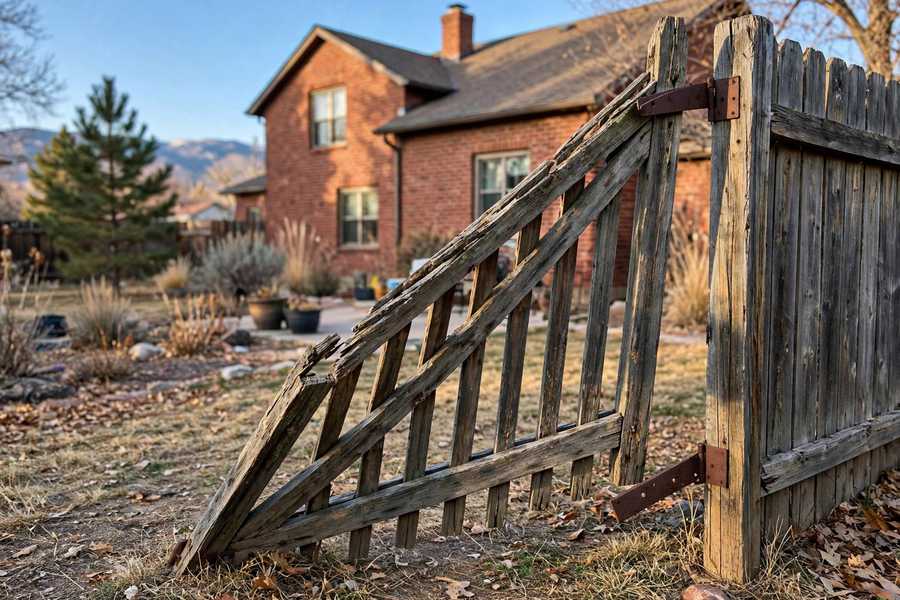
We find the cause before we fix anything: a leaning post, a rotted base, a failed footing, a racked gate frame. Fixing the symptom without the cause is how a repair fails twice.
Every fence repair we do comes with the same core scope: diagnosis, the failed parts fixed, and cleanup. Here is what is covered, and what we will flag before we start if the fence needs more than a repair.
We find the cause before we fix anything: a leaning post, a rotted base, a failed footing, a racked gate frame. Fixing the symptom without the cause is how a repair fails twice.
A failed post is dug out and a new pressure-treated post goes in deep in fresh concrete — frost depth in the Denver metro is commonly cited at about 36 inches — because a repair post set shallow will lean again within a winter.
Broken rails and pickets are replaced and matched to the existing fence as closely as the material allows. Weathered cedar will not match new cedar exactly, and we say so before we start.
A sagging gate is diagnosed first — hinge, post, or frame — then fixed with proper hardware and a brace, and tested. Post replacement is a repair sub-service, not a separate page, and it is covered here.
Hail season runs mid-April to mid-September, and the 8 May 2017 storm caused $2.3 billion in insured losses across the metro. We repair hail-cracked vinyl, wind-blown panels, and storm-leaned posts, and we document the damage for your records.
Old posts, footings, and scrap all go in the trailer. We rake the work area, sweep the driveway, and walk the line with you before we leave.
Fence repair Denver CO is the process of finding the failed part of a fence and fixing it: digging out a rotted post and setting a new one in concrete, replacing broken rails and pickets, rehanging a sagging gate, or re-tensioning a slack chain link run. The work is diagnosis first — a leaning fence can be a shallow footing, a rotted base, or a wind-loaded run, and each one has a different fix.
Most Denver fences fail at the post line. Bentonite clay holds water against the post base, freeze-thaw ground heaves shallow footings, and chinook wind loads a solid run. Denver's housing stock is old — the median year built is 1975 and more than half of homes predate 1980 — so plenty of fences are 15 or 20 years old and failing at the same time as the houses are being renovated.
Every job follows the same four steps, whether it is one leaning post in Baker or a wind-blown section in University Hills. You will know what happens each day.
Call
Call (720) 697-2456, Monday through Sunday, 7:00 AM to 8:00 PM, and we will talk through the fence repair, the yard, and the lot, and set a time to measure.
Diagnose
We walk the line, find the failed parts, and tell you what caused the failure — and whether a repair will hold or whether replacement is the better call.
Repair
The failed posts, rails, pickets, or gate parts are replaced and the fence is brought back to plumb. We keep the site tidy as we go.
Walk-through
We walk the repair with you when the build is done, check every gate and latch, and clear the site before we leave.
Post hole digger and auger
Used to dig out a failed footing and bore a clean hole deep enough to clear the frost line for the new post.
String line and level
The string line keeps the repaired section straight with the rest of the fence, and the level keeps the new post plumb. A repair that does not line up with the old fence shows immediately.
Circular saw and nail gun
The circular saw cuts replacement pickets and rails to length, and the nail gun fastens them consistent with the existing fence.
Tamper and wheelbarrow
The tamper packs soil around the new footing so the post does not shift, and the wheelbarrow moves concrete mix to the hole.
Fence pliers and wire tensioner
Fence pliers pull staples and twist wire, and the wire tensioner gets a slack chain link run tight again so it does not sag.
Gate brackets and heavy hinges
Used on sagging gates to add structural strength. A bracketed gate resists racking far better than nails alone.
Posts set below Denver frost depth
Frost depth in the Denver metro is commonly cited at about 36 inches, and the exact code figure for fence posts is not settled in the sources we reviewed — so we treat 36 inches as the floor, never the target, and set repair posts in concrete.
Fix the cause, not the symptom
A leaning post can be a shallow footing, a rotted base, or a wind-loaded run. We diagnose the cause before we fix anything, because fixing the symptom is how a repair fails twice.
Match the existing fence
Replacement boards are matched to the existing fence as closely as the material allows. Weathered cedar will not match new cedar exactly, and we say so before we start.
Repair or replace, decided honestly
If more than a third of the posts are failed, or the rails are rotted through, a repair is throwing good money after bad. Our fence-replacement page covers the repair-vs-replace decision in full.
01
What we do:We walk the line, find the failed posts and rails, and tell you whether the section can be rebuilt on the existing footings or whether the posts have to come out. The failed parts are replaced and the section is brought back to plumb.
→ A fence that is straight again, without paying for a full replacement if the rest of the line is sound.
02
What we do:We diagnose the cause first — hinge, post, or frame — then fix the actual problem with proper hardware and a brace, and test the swing and the latch.
→ A gate that swings clean and latches every time, on a post that will not lean again.
03
What we do:We check each post base for soft wood. The rotted posts are dug out and new pressure-treated posts go in fresh concrete, with a rot board at the base so the pickets never touch wet soil.
→ A fence line that stands on solid posts again, with the rot source addressed, not just the symptom.
04
What we do:We check the panels, rails, and posts for hidden damage, replace the cracked panels individually, and talk through whether the panel spec or the material itself is the right call for an exposed lot.
→ A fence that is whole again, with the hail risk talked through honestly.
Denver's repair season follows its weather: hail season runs mid-April to mid-September, chinook wind loads solid runs all winter, and freeze-thaw ground heaves shallow posts every spring. The most common repair in the city is a leaning post — bentonite clay holds water against the base, the footing heaves, and the post goes out of plumb. The second most common is a sagging gate, which is almost always a leaning gate post, not a bad gate. Diagnosis is the job; the fix follows from it.
Post-war brick ranches from the 1940s and 1950s, mostly with fenced back yards already. Heavy clay holds water against posts, and detached garages and alleys shape most rear fence lines. On these streets, a fence repair is the usual call.
Victorian and Queen Anne homes from the 1870s to 1890s on narrow lots. Part of Baker is a Denver landmark district, where a fence needs a permit at any height and front fences must stay low and mostly open — check per address. A fence repair is the usual call on these streets.
Craftsman bungalows and Denver Squares from 1893 to 1939, with intense scrape-and-rebuild. New two-storey builds overlook original bungalow yards, which drives rear privacy work. These streets usually call for a fence repair.
Denver's densest neighborhood, mostly apartments and converted mansions. The fence work here is usually courtyard, parking-area, and rear enclosures rather than a suburban backyard run. On these streets, a fence repair is the usual call.
About 4,000 homes built between 1954 and 1957, including 130 to 170 Cliff May prefab ranches — the largest Cliff May tract outside California. Flat, wide lots with detached garages and private courtyards. A fence repair is the usual call on these streets.
Freeze-thaw cycles that heave shallow posts
Denver's freeze-thaw ground lifts shallow posts within a winter or two. Frost depth is commonly cited at about 36 inches in the metro, and posts set shallower than that are the usual cause of a leaning fence. For a fence repair, that means posts set deep in concrete — shallow footings are the first thing we check.
Bentonite clay that holds water against posts
Expansive bentonite clay swells when wet and shrinks when dry, and it drains slowly, so post bases stay wet. Pressure-treated posts and a rot board at the base keep pickets out of the wettest soil. On a fence repair job, the post bases get pressure-treated stock and a rot board to keep the wood out of the wet soil.
Hail Alley — the 8 May 2017 storm cost $2.3 billion insured
Denver sits in Hail Alley, with 7 to 9 hail days a year. The 8 May 2017 storm caused $2.3 billion in insured losses across the metro. Vinyl is the most hail-vulnerable fence material; wood and metal fare better. A fence repair has to be planned for Hail Alley — the material either takes a stone or it does not.
Chinook wind that loads solid fences
Chinook gusts on the Front Range can top 80 mph on the I-25 corridor. A solid 6-foot privacy run catches the full wind load, which is why posts, footings, and rail fastening matter more than the pickets. For a fence repair, that means posts, footings, and rail fastening sized for the wind load — the panels are the easy part.
Most repair calls start with a problem, not a wish list. Here are the four we hear most often, and how we handle each one.
Problem
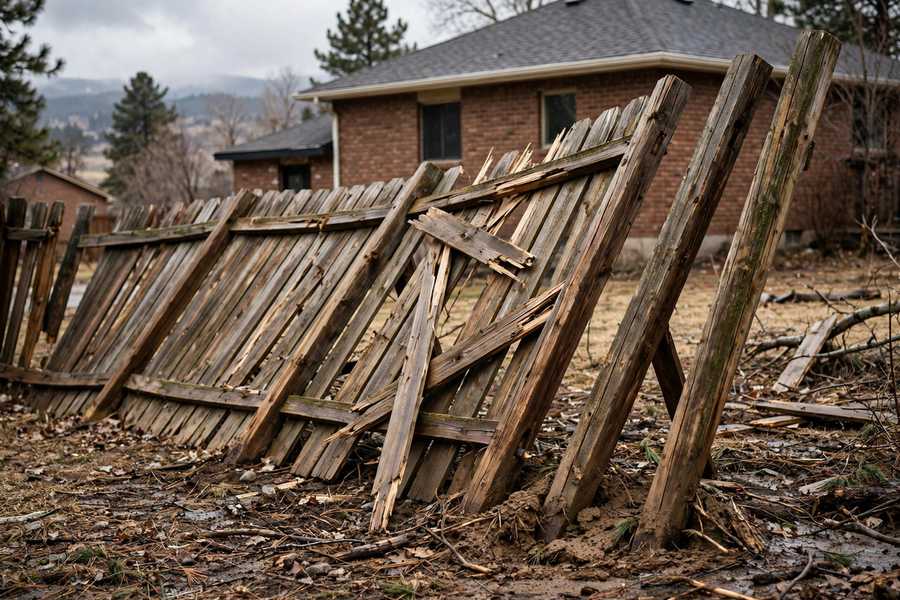
A leaning post pulls the rails and pickets out of line, and the whole section starts to rack. Left alone, the fence eventually falls into the neighbor's yard or the alley.
Our Fix
We dig out the old footing, set a new post deep in fresh concrete, and rehang the rails and pickets. If the wood is still sound, you keep it. Most leaning-post repairs are done in a single visit.
Problem
Bentonite clay holds water against the post base, and a post that sits in wet soil rots from the bottom up. The fence looks fine until the day it leans.
Our Fix
We check each post base for soft wood, dig out the rotted posts, and set new pressure-treated posts in fresh concrete with a rot board at the base so the pickets never touch wet soil.
Problem
A dragging gate is annoying, but it also means the frame is racking. Keep forcing it and the hinges pull out of the post, and now you need a new post, not just a new gate.
Our Fix
We diagnose the cause first. Sometimes it is a hinge, sometimes a rotted post, sometimes a missing diagonal brace. We fix the actual problem with proper hardware and a brace, then test the swing.
Problem
Hail season runs mid-April to mid-September, and chinook wind loads solid runs all winter. A wind-blown section or a hail-cracked panel is the most common storm repair in the city.
Our Fix
We walk the line, document the damage, replace the failed parts, and tell you plainly whether the rest of the fence is sound or whether replacement is the better call.
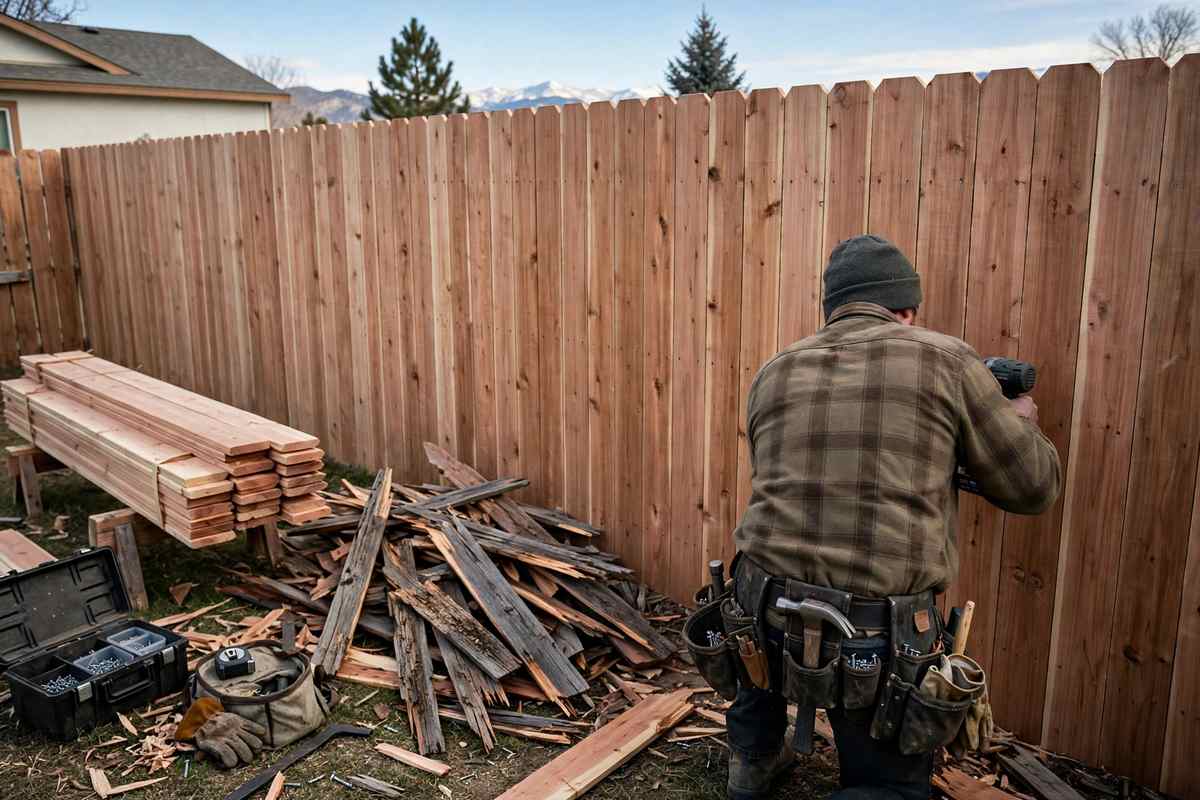
A repair is the right call when the fence is mostly sound and the failure is local. Here is what you actually get when we repair yours — and the point where we will tell you to replace instead.
Fix the failed parts, keep the good ones
When three posts have heaved and the rest of the fence is sound, we replace three posts. You do not pay for a new fence because part of the old one failed.
Diagnosis before work
We find the cause before we fix anything. A leaning post can be a shallow footing, a rotted base, or a wind-loaded run, and each one has a different fix.
Matched to the existing fence
Replacement boards are matched to the existing fence as closely as the material allows. Weathered cedar will not match new cedar exactly, and we say so before we start.
When a repair is not the right call
If more than a third of the posts are failed, or the rails are rotted through, a repair is throwing good money after bad. Our fence-replacement page covers the repair-vs-replace decision in full, and we will point you there when the numbers say so.
Google ★★★★★4.9 out of 5
Rated 4.9 out of 5 from 27 Google reviews. Read the reviews on our Google Business Profile, or call (720) 697-2456 to talk about your fence.
Fence repair in Denver is a diagnosis job: bentonite clay, freeze-thaw ground, hail, and chinook wind each fail a fence in a different way, and the fix follows from the cause. We repair the failed parts, match the existing fence, and tell you plainly when the fence is past repairing.
Payless Fence Company is rated 4.9 out of 5 from 27 Google reviews. The rating covers our Denver fence work — repairs included — and the individual reviews live on Google. Call (720) 697-2456 to talk about your fence repair.
★★★★★
4.9 out of 5
Based on 27 Google reviews for Payless Fence Company. We do not publish customer quotes on this page; read the reviews on Google, then call us to talk about your fence.
Call (720) 697-2456Real answers to the questions we hear most often on fence repair jobs, from local homeowners and property managers.
Full fence replacement and repair-vs-replace guidance for aging fences. Often the next step after a fence repair.
View Fence ReplacementCedar and pressure-treated pine fences built for Denver clay, frost, and hail. Often specified alongside a fence repair.
View Wood Fence InstallationManual walk and driveway gates, braced and hung to swing clean. A common companion to a fence repair.
View Gate InstallationLow-upkeep vinyl privacy and picket fences that hold up to Front Range sun. Often the next step after a fence repair.
View Vinyl Fence InstallationGalvanized and vinyl-coated chain link for yards, dog runs, and side lots. Often specified alongside a fence repair.
View Chain Link Fence InstallationFull-height 6-foot privacy runs for backyards, alleys, and patios. A common companion to a fence repair.
View Privacy Fence InstallationCall (720) 697-2456 to talk about a fence repair. We answer Monday through Sunday, 7:00 AM to 8:00 PM. Have the failure described — leaning posts, rotted bases, a sagging gate, storm damage — and your neighborhood ready, and we can talk through the next steps on the call.
Phone
(720) 697-2456Address
Payless Fence Company LLC, Denver, CO 80201, US
Hours
Mon–Sun 7:00 AM–8:00 PM