Removal of the old fence
The old fence comes down, the footings are dug out, and everything is hauled away. Removal is part of the replacement scope — there is no standalone fence-removal service, and the old fence does not stay in your yard.
Every fence replacement we do comes with the same core scope: removal, new footings, new fence, and cleanup. Here is what is covered, and what we will flag before we start if your lot needs something different.
The old fence comes down, the footings are dug out, and everything is hauled away. Removal is part of the replacement scope — there is no standalone fence-removal service, and the old fence does not stay in your yard.
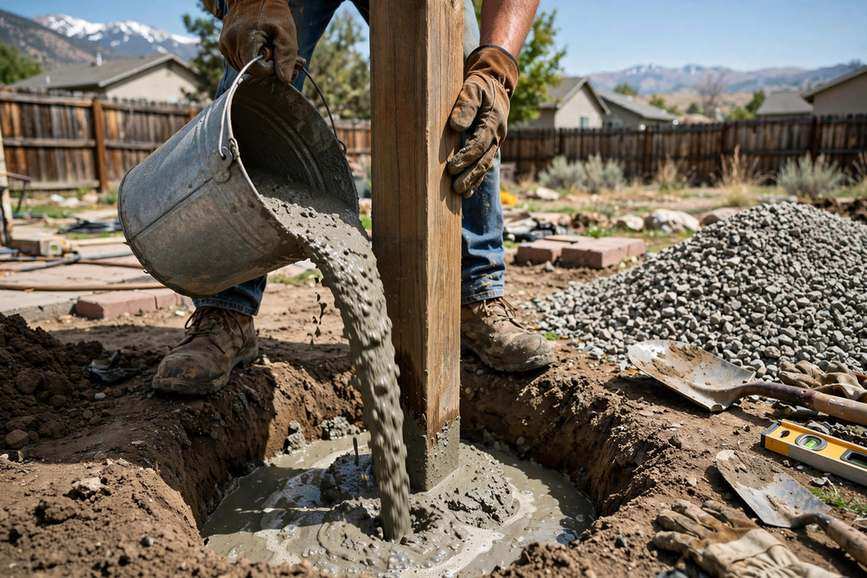
New posts go deep in concrete — frost depth in the Denver metro is commonly cited at about 36 inches — because a replacement fence on shallow footings will lean again within a winter.
We build the replacement in cedar, vinyl, composite, chain link, aluminum, or iron, matched to the house and the lot. The material choice is talked through before ordering, not after.
A replacement fence gets new gates, built square and hung on deep-set posts. Reusing an old gate on a new fence is how a new fence gets an old problem.
We check the Denver rules for your address — 4 feet in front of the primary facade, 6 feet behind it, zoning permit over 4 feet — and help with HOA submittals. A like-for-like replacement of a fence that already had a permit is generally exempt when nothing changes; anything else needs a permit.
Old fence, footings, and scrap all go in the trailer. We rake the work area, sweep the driveway, and walk the new line with you before we leave.
Fence replacement Denver CO is the process of taking down an old fence, digging out its footings, and building a new fence on the same line — or a new line, if the old one was in the wrong place. The work is mostly removal: the old posts have to come out of the ground, the concrete has to be broken out, and the site has to be cleared before the new posts go in. The new fence is then built the same way a first-time fence is built, with deep footings and a straight line.
Most Denver replacements happen for one of three reasons: the fence is 15 or 20 years old and failing at the post line in bentonite clay, a windstorm or hail season has taken out a section too big to patch, or a new build has gone up next door and the old fence no longer gives the privacy the yard needs. Denver's housing stock is old — the median year built is 1975 — so replacement is a concentrated market: whole blocks of fences are failing at the same age.
Every job follows the same four steps, whether it is a 40-foot side yard in Baker or a 300-foot perimeter in University Hills. You will know what happens each day.
Call
Call (720) 697-2456, Monday through Sunday, 7:00 AM to 8:00 PM. Tell us about the fence replacement, the yard, and the lot, and we will set a time to measure.
Measure & decide
We walk the line, check every post and rail, and tell you honestly whether repair or replacement is the better call — and what each one involves for your fence.
Replace
The old fence comes down, the footings come out, and the new fence goes up on deep concrete footings. We keep the site tidy as we go.
Walk-through
The last step is a walk of the finished replacement with you — every gate and latch checked, the site cleared before we leave.
Post hole digger and auger
Used to dig out old footings and bore clean holes deep enough to clear the frost line for the new posts.
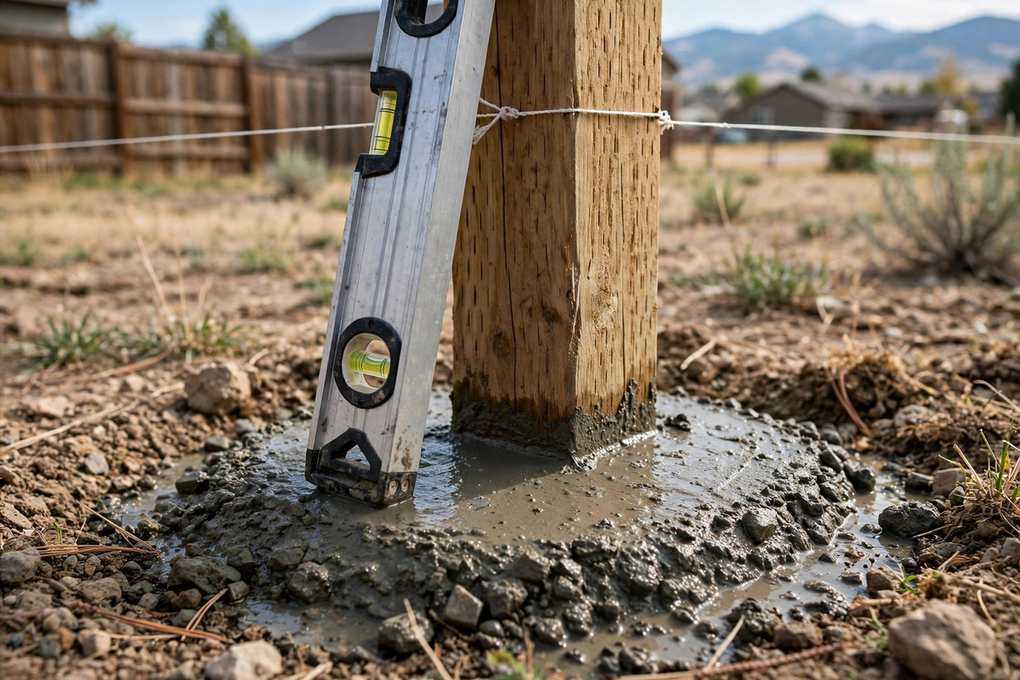
String line and level
The string line keeps the new fence straight over 100 feet, and the level keeps every post plumb. A replacement fence is a chance to fix a crooked line — and we take it.
Circular saw and nail gun
The circular saw cuts pickets and rails to length, and the nail gun fastens them fast and consistent.
Tamper and wheelbarrow
The tamper packs soil around each new footing so the post does not shift, and the wheelbarrow moves concrete mix to the hole.
Demolition bar and sledge
Used to break out old concrete footings. A footing that stays in the ground is a footing the new post has to work around.
Gate brackets and heavy hinges
Used on new gates to add structural strength. A bracketed gate resists racking far better than nails alone.
Posts set below Denver frost depth
Frost depth in the Denver metro is commonly cited at about 36 inches, and the exact code figure for fence posts is not settled in the sources we reviewed — so we treat 36 inches as the floor, never the target, and set new posts in concrete.
Old footings out, not worked around
The old footings are dug out and hauled away. A new post set next to an old footing is a new post that will lean toward the old hole.
Repair-vs-replace decided honestly
If more than a third of the posts are failed, or the rails are rotted through, replacement is the better call. If the fence is mostly sound, we will point you to our fence-repair page instead.
Like-for-like where the permit allows
A like-for-like replacement of a fence that already had a permit is generally exempt from a new zoning permit when nothing changes in location, footprint, or height. Anything else needs a permit, and we plan for that.
01
What we do:We walk the line, check every post base for soft wood, and count the failures. If more than a third of the posts are gone, we talk through replacement in the material that suits the house and the lot.
→ A new fence on deep footings, with the old fence and its footings gone.
02
What we do:We walk the line, find the failed posts and rails, and tell you whether the section can be rebuilt or whether the whole run has to come down. The failed parts are replaced or the run is rebuilt, whichever the fence actually needs.
→ A fence that is straight again, without paying for a full replacement if the rest of the line is sound.
03
What we do:We measure the overlooked side, confirm the 6-foot rear height rule for the lot, and build a solid privacy run where the old fence stood. The replacement is scoped to the side that is overlooked, not the whole lot.
→ A backyard that is private again, on a fence that will last.
04
What we do:We walk the line and count the patches. A fence that has been repaired in sections for a decade is usually past repairing, and the honest call is a full replacement on new footings.
→ One fence, one age, one line — instead of a patchwork that keeps failing.
Denver's replacement market is driven by age: the median year built is 1975, more than half of homes predate 1980, and whole blocks of fences went up in the same decade and are failing at the same time. The failure is almost always at the post line — bentonite clay holds water against the base, freeze-thaw ground heaves shallow footings, and a fence that was set 24 inches deep in 1995 is leaning in 2026. Replacement is the chance to fix the footing depth that the original fence got wrong.
Master-planned community on the former Stapleton airport, built mostly 2002 to 2019. The Master Community Association and sub-associations review fence designs before the city permit — two approvals, in that order. On these streets, a full fence replacement is the usual call.
Brick ranches from the 1950s to early 1970s on generous lots, with the High Line Canal running through the middle. Large corner lots are common, and I-25 bounds the east edge. A full fence replacement is the usual call on these streets.
Brick homes from 1900 to 1940 around a 165-acre park. Park-facing fronts stay low and open; the solid 6-foot fence belongs at the rear. Local installers flag the heavy clay here and set posts deeper than the Denver norm. These streets usually call for a full fence replacement.
A collective hub for North, South, and Northeast Park Hill — three official neighborhoods, not one. The proposed 32-block South Park Hill historic district is proposed, not designated, and Montview Boulevard and 17th Avenue are designated parkways. On these streets, a full fence replacement is the usual call.
Modest 1950s brick ranches subdivided in the early 1950s. Several homes back directly onto Ash Grove Park or Cook Park with private gates — a park-gate fence is a documented feature here. A full fence replacement is the usual call on these streets.
Freeze-thaw cycles that heave shallow posts
Denver's freeze-thaw ground lifts shallow posts within a winter or two. Frost depth is commonly cited at about 36 inches in the metro, and posts set shallower than that are the usual cause of a leaning fence. For a fence replacement, that means posts set deep in concrete — shallow footings are the first thing we check.
Bentonite clay that holds water against posts
Expansive bentonite clay swells when wet and shrinks when dry, and it drains slowly, so post bases stay wet. Pressure-treated posts and a rot board at the base keep pickets out of the wettest soil. On a fence replacement job, the post bases get pressure-treated stock and a rot board to keep the wood out of the wet soil.
Chinook wind that loads solid fences
Chinook gusts on the Front Range can top 80 mph on the I-25 corridor. A solid 6-foot privacy run catches the full wind load, which is why posts, footings, and rail fastening matter more than the pickets. A fence replacement has to be planned for Chinook gusts — posts, footings, and fastening carry the load.
Denver permit and sight-triangle rules
Denver caps fences at 4 feet in front of the primary street-facing facade and 6 feet behind it, and any fence over 4 feet needs a zoning permit. Corner lots have sight-triangle limits near intersections, and fences sit at least 6 inches back from the public sidewalk. For a fence replacement, we check the height and the sight triangle for your address before we quote.
Most replacement calls start with a fence that has been patched too many times. Here are the four signs we look for, and how we handle each one.
Problem
A fence with a third of its posts rotted or heaved is not a repair job — it is a fence that is failing everywhere at once, and patching it is throwing good money after bad.
Our Fix
We count the failures with you, then talk through replacement in the material that suits the house and the lot. The old fence and its footings come out, and the new fence goes up on deep footings.
Problem
Rails rot from the inside where water sits against them, and a rail that is soft along its length will not hold pickets no matter how many new posts go in.
Our Fix
We check the rails along the whole run. If they are rotted through, the fence comes down and a new one goes up — a rail-by-rail repair would cost more than the replacement.
Problem
A fence repaired in sections for a decade is three fences of three ages, and each section fails on its own schedule. The line is never straight, and the gate never quite works.
Our Fix
We talk through a full replacement on new footings, with one material, one age, and one straight line — and we say so plainly if the fence still has life in it.
Problem
A fence built on the wrong line, or a 6-foot fence in front of the primary facade, is a compliance problem as well as a fence problem. Patching it does not fix the line or the height.
Our Fix
We check the Denver height rules and the permit picture for the address, then talk through a replacement on the right line at the right height — and whether the old fence can stay while the new one goes up.
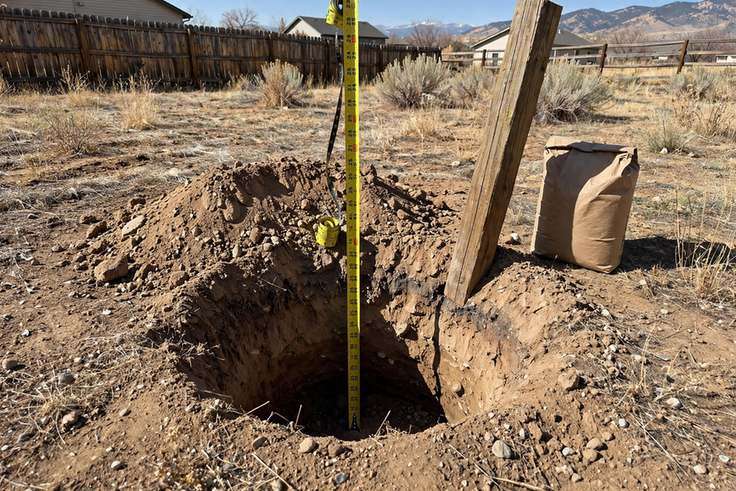
Replacement is the right call when the fence is past patching. Here is what you actually get when we replace yours — and how we decide it is time.
One fence, one age, one line
A replacement is a single fence built in one pass, on new footings, with one material. No patchwork, no three ages, no line that wanders.
Fix the footing depth the original got wrong
Most Denver fences fail because they were set too shallow in bentonite clay. A replacement is the chance to set the posts deep — frost depth is commonly cited at about 36 inches in the metro — and break the lean-repair-lean cycle.
A material choice made for the lot
Replacement is the moment to change material: cedar to vinyl for no upkeep, chain link to cedar for privacy, iron to aluminum for no rust. We talk through the choice before ordering.
What fence replacement costs in the Denver market
Published Denver figures for old-fence removal conflict — NumeralQ (Oct 2026) shows $3.95 to $5.13 per foot, while Angi shows $10 to $17 per foot — and replacement pricing follows the new material's market range. Those are market ranges, not Payless Fence Company prices. Call (720) 697-2456 with your fence length and material and we will talk through a quote for your yard.
Google ★★★★★4.9 out of 5
Rated 4.9 out of 5 from 27 Google reviews. Read the reviews on our Google Business Profile, or call (720) 697-2456 to talk about your fence.
Fence replacement in Denver is a removal job as much as a build job: old footings have to come out of bentonite clay, the new posts have to go in deep, and the repair-vs-replace call has to be made honestly. We replace the fence when the fence is past repairing — and we will point you to repair when it is not.
Payless Fence Company is rated 4.9 out of 5 from 27 Google reviews. We show the aggregate rating here, not individual review text. Call (720) 697-2456 to talk about your fence replacement.
★★★★★
4.9 out of 5
Based on 27 Google reviews for Payless Fence Company. We do not publish customer quotes on this page; read the reviews on Google, then call us to talk about your fence.
Call (720) 697-2456The questions we hear most often about fence replacement, answered for local homeowners and property managers.
Post, rail, picket, and gate repairs, including storm and freeze-thaw damage. Often the next step after a fence replacement.
View Fence RepairCedar and pressure-treated pine fences built for Denver clay, frost, and hail. Often specified alongside a fence replacement.
View Wood Fence InstallationFull-height 6-foot privacy runs for backyards, alleys, and patios. A common companion to a fence replacement.
View Privacy Fence InstallationLow-upkeep vinyl privacy and picket fences that hold up to Front Range sun. Often the next step after a fence replacement.
View Vinyl Fence InstallationWood-look composite boards that skip the re-stain cycle. Often specified alongside a fence replacement.
View Composite Fence InstallationManual walk and driveway gates, braced and hung to swing clean. A common companion to a fence replacement.
View Gate InstallationCall (720) 697-2456 to talk about a fence replacement. We answer Monday through Sunday, 7:00 AM to 8:00 PM. Have your fence length, the material you are considering, and your neighborhood ready, and we can talk through the next steps on the call.
Phone
(720) 697-2456Address
Payless Fence Company LLC, Denver, CO 80201, US
Hours
Mon–Sun 7:00 AM–8:00 PM